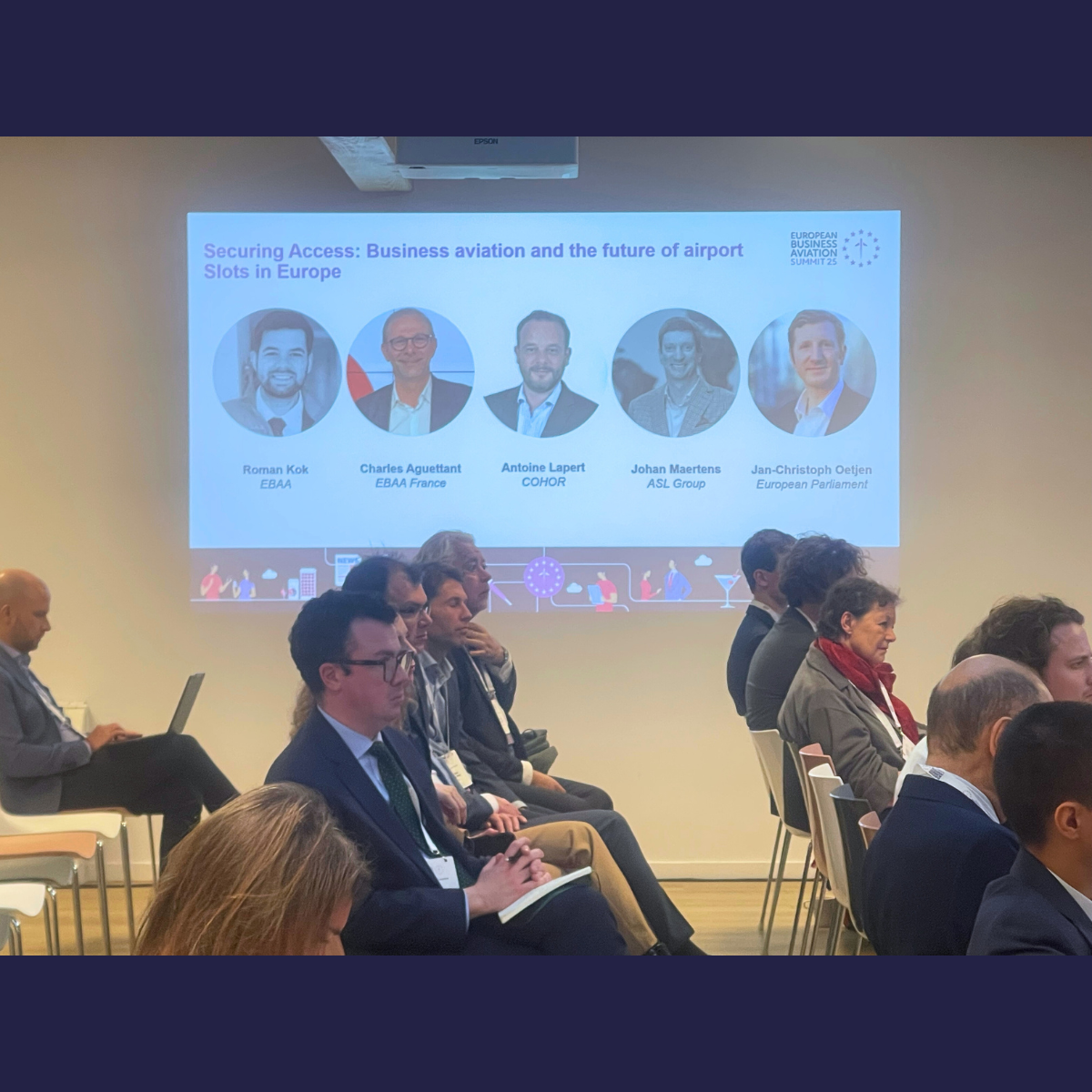
On 8 December, EBAA hosted the fourth edition of the European Business Aviation Summit (EBAS) in Brussels. In the first full year of RefuelEU Aviation and on the cusp of 2026, EBAS 2025 put business aviation at the centre of three key debates: sustainable aviation fuels & anti-tankering, airport slots, and innovation policy. For those who could not be with us in Brussels, this report offers a snapshot of how EBAS is used to advance your interests.
Across the afternoon, EBAS 2025 gathered senior EU and national policymakers alongside leading industry operators, fostering direct dialogue with EBAA members. Thanks to the support of our main sponsor NetJets, the discussions continued during a well attended networking reception, where many of these policy conversations carried on informally. For members, EBAS 2025 was a concrete instrument for lobbying, relationship building and agenda setting.
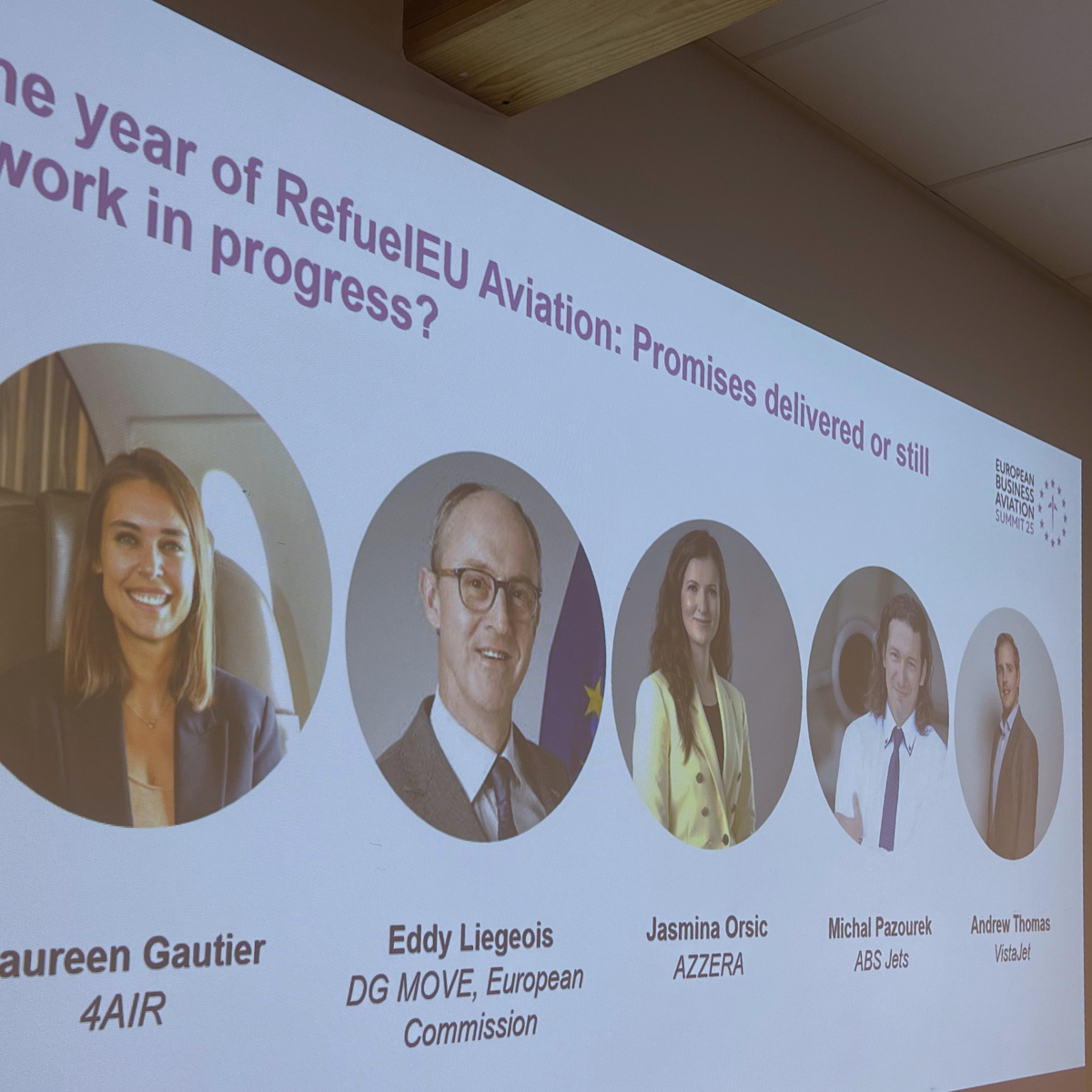
Panel 1 – One year of RefuelEU Aviation: Promises delivered or still a work in progress?
The first panel took stock of RefuelEU Aviation one year after entry into force, with a clear focus on what the Regulation means in practice for business aviation operators.
Head of Unit Eddy Liégeois (DG MOVE) provided the Commission’s perspective on the state of play, underlining that more transparency is needed in the SAF market if Europe is to deliver on its decarbonisation goals. Industry representatives from ABS Jets (Andrew Thomas), VistaJet (Michal Pazourek), Azzera (Jasmina Orsic) and 4AIR (Maureen Gautier) brought operational experience to the table, highlighting:
- Ongoing challenges in SAF availability and price
- Questions around how anti-tankering obligations will work for smaller operators with complex routings
- The importance of recognising credible book and claim models that reflect the reality of business aviation operations
For EBAA members, this session ensured that business aviation spoke with a coherent, pragmatic voice to DG MOVE and helped us test and reinforce key messages ahead of the 2027 RefuelEU review, particularly on transparency, anti-tankering and book and claim, which will shape our advocacy with the Commission and Member States.
Further details and pictures available here.
Panel 2 – Securing Access: Business aviation and the future of airport Slots in Europe
The second panel moved to one of the most pressing issues for operators in Europe: access to airport capacity.
From Nice to Amsterdam, EBAA members are facing growing constraints when it comes to securing slots. As the European Commission prepares a revision of the EU Slot Regulation and national airports adopt a more confrontational stance, EBAS 2025 provided a rare opportunity to put all sides around the same table.
The discussion, moderated by Róman Kok, brought together Johan Maertens (ASL Group), Antoine Lapert (COHOR), MEP Jan-Christoph Oetjen and Charles Aguettant (EBAA France). Speakers underlined that while the current system is formally non discriminatory, in practice it structurally disadvantages business aviation. Systematic overbooking by some operators creates artificial congestion, meaning airports look full on paper but are not used at true capacity, to the detriment of all users. Participants also stressed that business aviation cannot simply be forced into a rigid slot regime designed for scheduled airlines and that new rules must reflect the specific nature of unscheduled operations.
For our members, this panel delivered three clear gains: political recognition of the problem at TRAN level, visible alignment between Brussels and national advocacy, and a strong mandate for EBAA to press for slot rules that allow business aviation to operate without distorting airport capacity, while avoiding a zero-sum narrative with commercial airlines.
Further details and pictures available here.
Panel 3 – Is Europe losing the innovation battle in aviation? Supporting Business aviation as a catalyst for innovation
The final panel looked at Europe’s long term competitiveness in advanced aviation technologies and the role of business aviation as a catalyst for innovation.
Moderated by Federico Ricci Buffetti, the session brought together MEP Cynthia Ní Mhurchú, Taco Stouten (VÆRIDION) and Péter Márton (GAMA). Cynthia Ní Mhurchú stressed that “we should learn from what happened with electric cars and avoid being left behind again.”
The conclusion was clear. Europe has the talent, the industrial base and serious projects. What is missing is a coherent and predictable framework that allows innovators to scale and compete globally. For EBAA members, EBAS 2025 both positioned business aviation as a credible platform for early adoption and demonstration of new technologies, and opened the door for further dialogue with MEPs and industry partners on how European and national funding programmes can better take the needs of our segment into account.
Further details and video available here.
EBAS 2025: outcomes for members
Beyond the individual panels, EBAS 2025 confirmed EBAA’s position as the reference platform for policy dialogue on business aviation in Brussels. In concrete terms, the Summit:
- Brought senior policymakers (European Commission, European Parliament, national authorities) into direct contact with operators, manufacturers and service providers from our membership
- Provided a public stage for messages that many members have been raising with us privately, on SAF, anti tankering, slots and innovation funding
- Created high quality networking opportunities during the cocktail reception, where many participants continued the policy discussions in a less formal setting
The debates at EBAS are not an end in themselves. They are already feeding into our day-to-day advocacy and will inform our engagement with DG MOVE on RefuelEU implementation, with TRAN and national ministries on slots and access, and with EU institutions on innovation and funding initiatives.
In the coming weeks, the EBAA team will integrate the outcomes of EBAS 2025 into our work on RefuelEU Aviation, airport slots and innovation financing, follow up with institutional speakers and their teams, and draw on the quotes and examples shared at the Summit to strengthen our communication with policymakers and the media.